In 2026, AI analytics transforms digital marketing from a reactive discipline into a precise, predictive science. Marketers no longer wait for monthly reports to understand what worked. They get answers in seconds — about audience behavior, campaign performance, and revenue impact — powered by machine learning engines that never sleep. For business owners, enterprise teams, and SaaS startups navigating an increasingly competitive digital landscape, understanding how AI analytics transforms digital marketing is no longer optional. It is the defining edge between brands that grow and brands that stall.
What Is AI Analytics in Digital Marketing?
AI analytics in digital marketing refers to the application of artificial intelligence, machine learning, and natural language processing to collect, process, and interpret marketing data at scale. Unlike traditional analytics platforms that report on historical data, AI-powered systems model future outcomes, detect patterns invisible to human analysts, and deliver actionable recommendations in real time.
At its core, AI analytics combines several technologies:
- Machine Learning (ML): Identifies trends and anomalies across millions of data points
- Natural Language Processing (NLP): Interprets customer sentiment, search intent, and conversational data
- Predictive Modeling: Forecasts campaign outcomes, churn probability, and lifetime customer value
- Computer Vision: Analyzes visual content performance across social and display channels
- Generative AI: Assists with content optimization, ad copy testing, and personalization at scale
Together, these capabilities give marketing teams a unified intelligence layer that connects data from CRM systems, paid channels, owned media, and customer interactions into one continuous feedback loop. Platforms such as Google Analytics 4
and enterprise-grade solutions from Salesforce Marketing Cloud already embed AI layers that automate insight generation for marketing teams of every size.
Why Businesses Need AI Analytics in 2026
The digital advertising ecosystem has fundamentally changed. Privacy regulations, the deprecation of third-party cookies, and the explosion of zero-party data channels have reshaped how businesses collect and activate audience intelligence. At the same time, customer expectations for personalized, real-time experiences have never been higher.
Traditional analytics tools cannot keep pace. They rely on human analysts to build reports, interpret dashboards, and generate hypotheses — a process that takes days or weeks. By the time insights reach decision-makers, market
conditions have shifted. AI-powered marketing analytics tools close this gap by making analysis continuous, automatic, and prescriptive.
Consider the scale of modern marketing data. A mid-size e-commerce brand running campaigns across search, social, email, and programmatic channels generates millions of data events daily. No human team can process that volume fast enough to act on it. AI systems can — and they improve with every data point they process.
According to Gartner’s marketing research, organizations that invest in AI-driven marketing intelligence consistently outperform peers on conversion rates, customer retention, and marketing ROI. This trend accelerates in 2026 as AI models become more capable, more accessible, and more deeply integrated into core marketing stacks.
Key Benefits: How AI Analytics Transforms Digital Marketing
The most successful marketing organizations in 2026 treat AI analytics not as a point solution but as an operating system for their entire go-to-market strategy. Here are the core benefits driving adoption:
1. Real-Time Marketing Data Insights
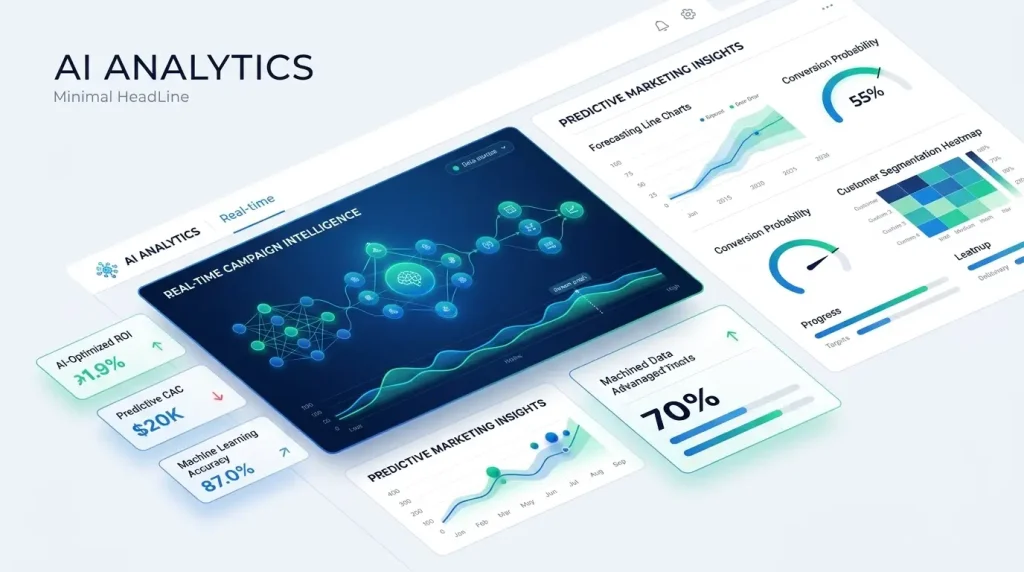
Real-time marketing data insights allow teams to respond to audience behavior as it happens. When a product page sees a sudden spike in drop-offs, AI systems flag it immediately — with probable causes and suggested fixes — rather than surfacing the issue in next week’s report. This speed transforms campaign management from reactive to proactive.
2. Predictive Analytics for Digital Marketing
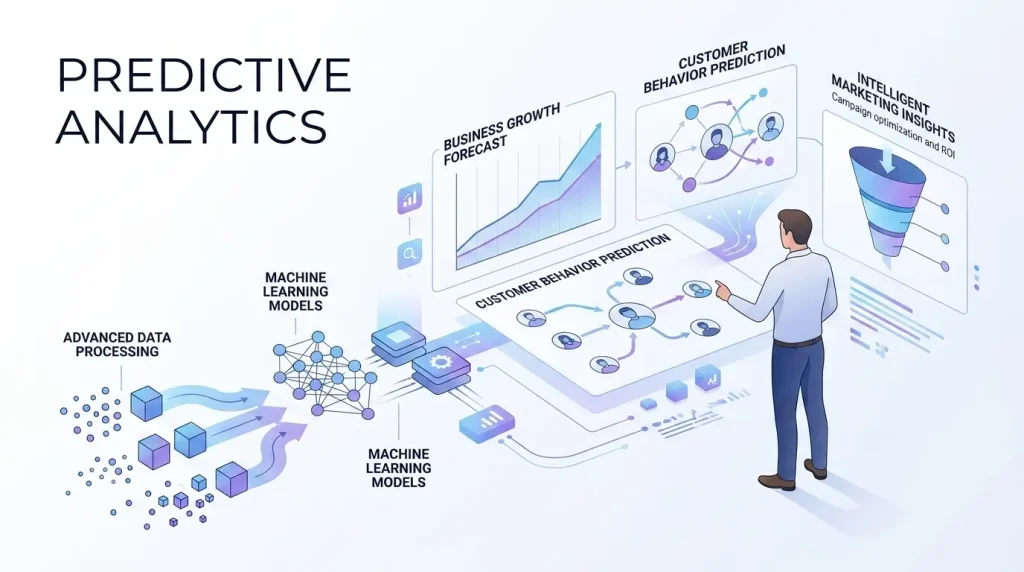
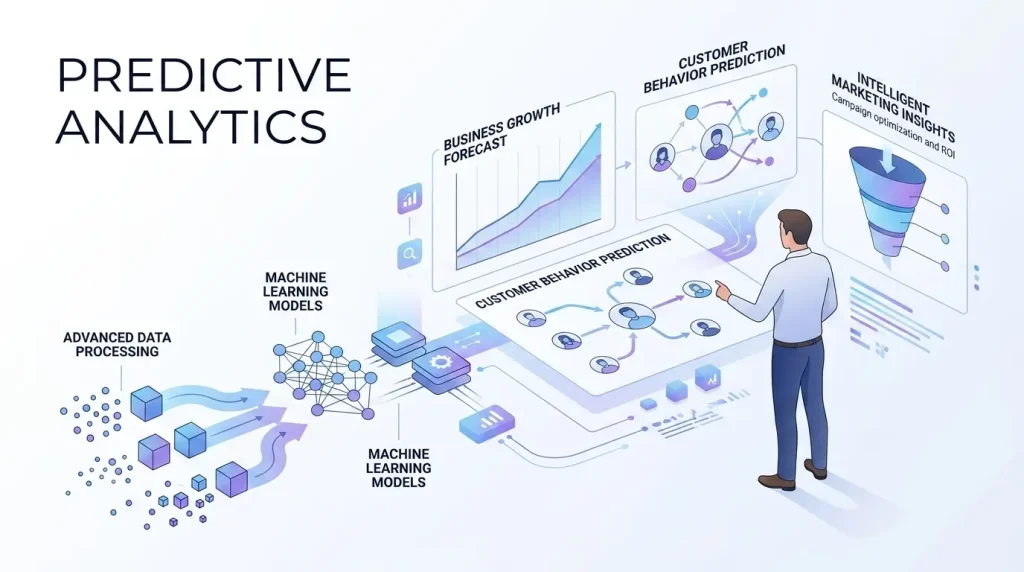
Predictive analytics for digital marketing enables brands to forecast which audiences are most likely to convert, which channels will deliver the best return, and which customers are at risk of churning — before any of these events occur. Marketing budgets shift from guesswork to calculated allocation, driving measurably better ROI on every campaign dollar.
3. Hyper-Personalization at Scale
AI models process behavioral signals, purchase history, session data, and contextual factors simultaneously to deliver personalized content, offers, and messaging to millions of users — all in real time. What previously required large segmentation teams and manual workflows now runs autonomously across every customer touchpoint.
4. Automated Campaign Optimization
Machine learning marketing optimization continuously tests ad creative, bidding strategies, audience targeting, and landing page variations. Rather than running A/B tests over weeks, AI systems run multivariate experiments continuously and reallocate budget to winning combinations automatically — compounding performance improvements daily.
5. Unified Customer Intelligence
AI analytics breaks down the data silos that fragment customer understanding across CRM, ad platforms, web analytics, and customer service systems. It creates a single, continuously updated customer profile that every team — from performance marketing to product — can act on in unison.
AI Analytics vs. Traditional Marketing Analytics: A Comparison
| Capability | Traditional Analytics | AI Analytics (2026) |
|---|---|---|
| Data Processing Speed | Batch reports (daily/weekly) | Real-time continuous processing |
| Insight Generation | Manual analyst interpretation | Automated, prescriptive recommendations |
| Personalization | Broad audience segments | Individual-level dynamic personalization |
| Campaign Optimization | Periodic A/B testing | Continuous multivariate optimization |
| Forecasting | Limited historical trending | Predictive modeling with scenario planning |
| Data Sources | Siloed by platform | Unified cross-channel intelligence |
| Anomaly Detection | Manual review required | Automated alerts with root cause analysis |
Real-World Use Cases in 2026
Understanding how AI analytics transforms digital marketing in practice requires looking at how leading organizations deploy it across different marketing functions.
E-Commerce: Dynamic Pricing and Personalized Product Discovery
Online retailers use AI analytics to model price elasticity in real time, adjusting product pricing based on demand signals, competitor activity, and individual customer purchase probability. Simultaneously, recommendation engines powered by deep learning surface the right products to the right customers — increasing average order value without increasing ad spend.
B2B SaaS: Account-Based Marketing Intelligence
SaaS companies leverage AI analytics to score accounts by purchase readiness, identify which companies are actively researching competitor solutions, and prioritize outreach accordingly. This transforms account-based marketing from a manual, relationship-driven process into a data-driven, scalable system that sales and marketing teams run in synchronized precision.
Media and Publishing: Content Performance Optimization
Digital publishers use AI analytics to identify which content formats, topics, and distribution channels drive the highest engagement and subscription conversions. NLP models analyze reader behavior at the sentence level — pinpointing exactly where audiences disengage — so editorial teams can optimize existing content and plan future pieces with far greater accuracy.
Healthcare Marketing: Compliant Patient Engagement
Healthcare organizations apply AI analytics to segment patient audiences with precision while maintaining strict HIPAA compliance, delivering relevant health content and appointment reminders at moments when patients are most likely to engage — improving both patient outcomes and operational efficiency.
Challenges and How to Solve Them
Deploying AI analytics at scale is not without friction. Understanding the common obstacles — and their solutions — helps businesses accelerate adoption without costly missteps.
Data Quality and Integration
Challenge: AI models are only as good as the data they consume. Fragmented, inconsistent, or incomplete data pipelines produce unreliable outputs.
Solution: Invest in a robust Customer Data Platform (CDP) before deploying advanced AI analytics. Clean, unified data is the foundation of every high-performing AI marketing system. Platforms like IBM Analytics provide enterprise-grade data governance frameworks that support AI readiness.
Talent and Organizational Readiness
Challenge: Many marketing teams lack the technical expertise to interpret AI outputs or challenge model recommendations critically.
Solution: Build AI literacy programs into marketing team development. The goal is not to turn marketers into data scientists — it is to ensure they understand what AI models can and cannot do, so they remain effective strategic directors of AI-driven systems.
Privacy Compliance
Challenge: GDPR, CCPA, and emerging regional privacy laws restrict how businesses collect and use personal data for marketing analytics.
Solution: Adopt privacy-first AI analytics architectures that rely on first-party and zero-party data, contextual signals, and privacy-preserving machine learning techniques such as federated learning and differential privacy.
Model Bias and Transparency
Challenge: AI models can perpetuate biases present in historical training data, leading to skewed targeting and optimization decisions.
Solution: Implement model monitoring, bias auditing, and explainable AI (XAI) practices that make model decisions transparent and correctable. Responsible AI governance frameworks from Microsoft’s Responsible AI initiative offer practical starting points for enterprise marketing teams. Also visit the DTMetrix blog page.
Future Trends: Where AI Analytics Is Heading
The trajectory of AI analytics for digital marketing in 2026 and beyond points toward even deeper integration, greater autonomy, and more sophisticated intelligence systems.
- Agentic AI in Marketing: Autonomous AI agents will manage entire campaign workflows — from brief to launch to optimization — requiring only high-level strategic direction from human marketers. Explore how OpenAI’s research on autonomous agents is shaping the next generation of marketing intelligence.
- Multimodal Analytics: AI systems will simultaneously analyze text, image, video, and audio performance data — giving marketers a holistic view of creative effectiveness across every format and channel.
- Causal AI: Moving beyond correlation, causal AI models will identify the true drivers of marketing outcomes — enabling marketers to make decisions based on genuine cause-and-effect relationships rather than statistical patterns alone.
- Composable Analytics Stacks: Modular AI analytics infrastructure will allow businesses to assemble best-in-class components from multiple vendors through open APIs — replacing monolithic platforms with flexible, interoperable systems.
- Edge AI for Real-Time Personalization: On-device AI processing will enable hyper-local, context-aware personalization even in low-connectivity environments — expanding the reach of real-time marketing intelligence to entirely new customer segments.
Best Practices for Implementing AI Analytics in Your Marketing Strategy
For businesses ready to act, the following practices accelerate AI analytics adoption while minimizing implementation risk:
- Audit your data infrastructure first. Map all data sources, assess data quality, and identify gaps before selecting any AI analytics platform. Garbage in, garbage out is the law that governs every AI system.
- Define clear business objectives. AI analytics delivers the most value when tied to specific, measurable goals — such as reducing customer acquisition cost by 20% or increasing email conversion rates by 15%. Avoid deploying AI for the sake of innovation alone.
- Start with high-impact, low-risk use cases. Predictive lead scoring, automated anomaly detection, and content performance optimization offer significant returns with relatively straightforward implementation. Build confidence and competency before tackling more complex applications.
- Build cross-functional AI teams. The most effective AI analytics programs involve collaboration between marketing, data engineering, IT, and legal teams. Siloed implementations consistently enderperform cross-functional ones.
- Establish model governance from day one. Document how AI models are trained, what data they use, how outputs are reviewed, and what escalation paths exist when systems produce unexpected results. Governance is not bureaucracy — it is how organizations maintain trust in AI-driven decisions at scale.
- Measure incrementality, not just correlation. Use controlled experiments and holdout groups to validate that AI-driven interventions genuinely drive business outcomes — not just that they correlate with positive trends.
Frequently Asked Questions
1. How does AI analytics transform digital marketing differently from traditional analytics?
AI analytics transforms digital marketing by processing data in real time, generating automated recommendations, and predicting future outcomes — capabilities traditional analytics platforms cannot match. While traditional tools report on what happened, AI analytics tells marketers what is happening now and what is likely to happen next, enabling faster and more accurate marketing decisions.
2. What are the best AI-powered marketing analytics tools in 2026?
Leading AI-powered marketing analytics tools in 2026 include Google Analytics 4 with its AI-driven insights, Salesforce Marketing Cloud Intelligence, Adobe Analytics with Sensei AI, HubSpot’s AI-powered reporting suite, and specialized platforms like Amplitude and MixPanel with built-in machine learning models for behavioral analytics and user journey optimization.
3. How does predictive analytics for digital marketing work?
Predictive analytics for digital marketing works by training machine learning models on historical customer and campaign data to forecast future behaviors — such as which users are most likely to convert, which campaigns will generate the best ROI, or which customers are at risk of churning. These models update continuously as new data flows in, making predictions progressively more accurate over time.
4. Is AI analytics suitable for small and medium-sized businesses?
Yes. Many AI analytics platforms in 2026 offer tiered pricing and modular features that make advanced capabilities accessible to SMBs without enterprise-level budgets. Tools like HubSpot, Google Analytics 4, and various SaaS-based marketing intelligence platforms provide AI-driven insights that scale from startups to global enterprises — with implementation complexity matched to organizational capacity.
5. How do companies ensure data privacy when using AI analytics?
Organizations ensure data privacy in AI analytics by adopting first-party data strategies, implementing privacy-by-design architectures, obtaining explicit user consent through compliant data collection frameworks, and using privacy-preserving AI techniques such as federated learning and data anonymization. Regular compliance audits aligned with GDPR, CCPA, and regional regulations are essential for any business deploying AI analytics
at scale.
Conclusion: AI Analytics Transforms Digital Marketing — Start Now
The evidence is clear: AI analytics transforms digital marketing in ways that deliver measurable, compounding competitive advantages. From real-time audience intelligence and predictive campaign optimization to hyper-personalization and autonomous marketing workflows, AI-powered analytics has moved from experimental technology to operational necessity.
Businesses that move decisively — building strong data foundations, selecting the right AI-powered marketing analytics tools, and embedding AI intelligence across their marketing operations — will define the top of their categories in 2026 and beyond. Those that delay will find the gap between themselves and AI-enabled competitors increasingly difficult to close.
The time to invest in AI analytics for digital marketing is not next quarter. It is now. The organizations winning today are those that started building their AI analytics capabilities yesterday — and they are already compounding the returns.
Ready to see how AI analytics can accelerate your digital marketing performance? Explore DtMetrix’s suite of AI-powered analytics and business intelligence solutions designed for growth-focused businesses in 2026.