AI Chatbots Improve Customer Support and Reduce Costs: The 2026 Enterprise Guide
AI Chatbots Improve Customer Support and Reduce Costs in ways that are no longer theoretical — they are measurable, scalable, and transforming how enterprises engage with customers. As businesses face mounting pressure to deliver faster resolutions, 24/7 availability, and personalized service without proportionally increasing headcount, AI-powered chatbots have emerged as the most practical and high-ROI solution in modern customer operations. This guide breaks down exactly how conversational AI delivers operational efficiency, what enterprises need to know before deploying it, and where the technology is heading next.
What Are AI Chatbots for Customer Support?
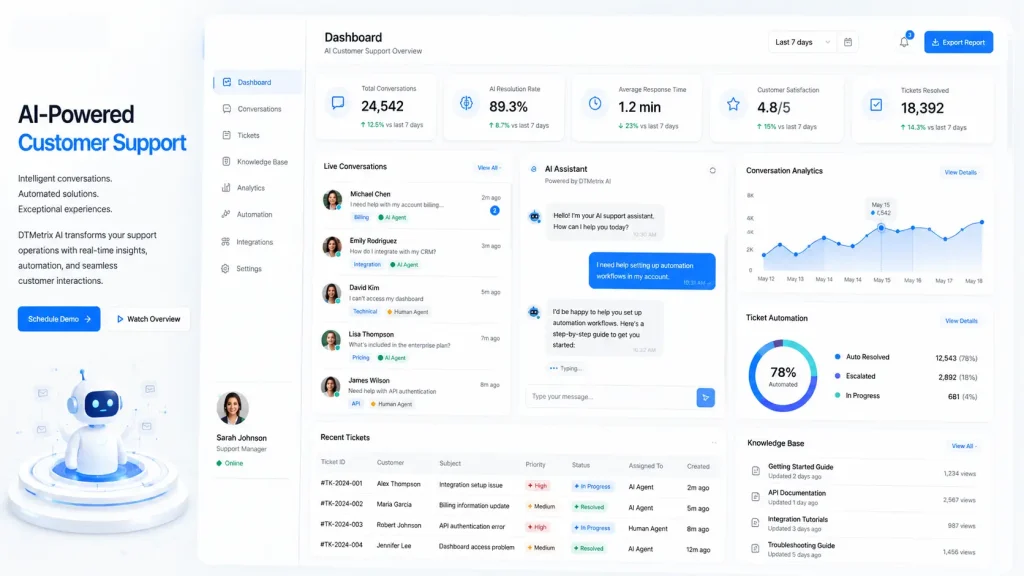
AI chatbots for customer support are software systems that use natural language processing (NLP), machine learning, and large language models (LLMs) to simulate human-like conversations with customers. Unlike rule-based bots that follow rigid decision trees, modern conversational AI can understand intent, context, and sentiment — enabling dynamic, helpful interactions without human involvement.
These systems integrate with CRM platforms, helpdesk software, e-commerce systems, and internal knowledge bases to retrieve real-time data and provide accurate, contextual answers. Leading enterprise platforms such as Salesforce Einstein and IBM Watson Assistant have pioneered this category, integrating deep workflow automation with natural language capabilities.
In practical terms, an AI chatbot can handle tasks including:
- Answering frequently asked questions instantly
- Processing returns, refunds, and order status requests
- Authenticating users and resetting credentials
- Escalating complex issues to human agents with full context
- Collecting customer feedback and sentiment data post-interaction
Why Businesses Need AI-Powered Customer Service Automation
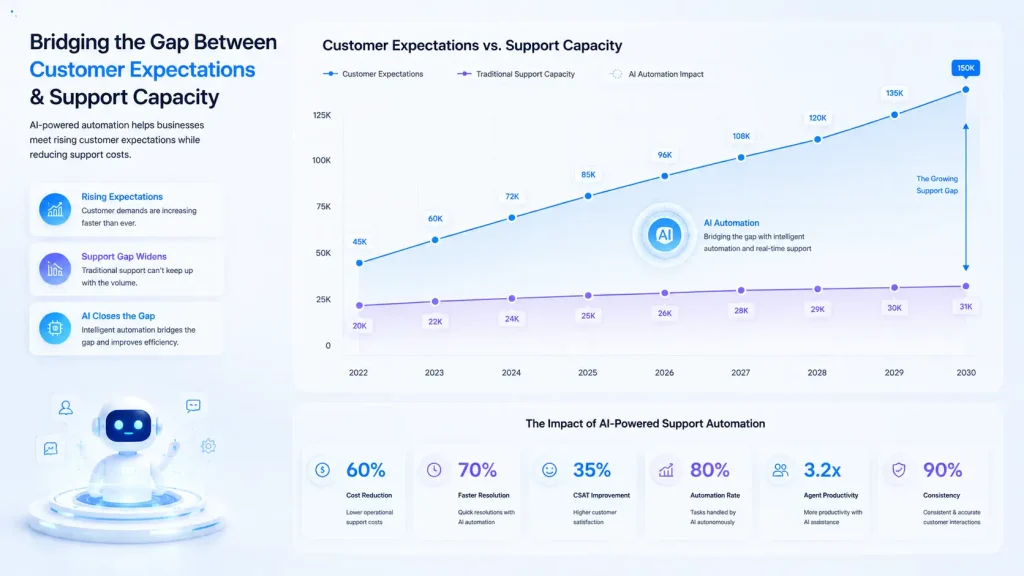
Customer expectations have fundamentally changed. According to research published by Salesforce’s State of the Connected Customer report, over 80% of customers now expect immediate responses when they contact a business. Meeting this expectation with human agents alone is cost-prohibitive for most organizations.
The core business problem is a mismatch between support volume growth and budget. Hiring and training customer support agents is expensive, time-consuming, and difficult to scale during demand spikes. AI-powered customer service automation directly addresses this by enabling elastic capacity — handling thousands of simultaneous conversations at a fraction of the cost per interaction.
Beyond cost, AI chatbots deliver consistency. Human agents vary in knowledge, tone, and performance. AI systems provide the same caliber of response at 2 AM on a holiday as they do during peak business hours — a critical advantage for global enterprises operating across time zones.
Key Benefits: How AI Chatbots Improve Customer Support and Reduce Costs
Understanding the full ROI of deploying conversational AI requires looking beyond simple ticket deflection rates. The benefits span operational efficiency, customer satisfaction, data intelligence, and long-term cost structure.
1. Significant Reduction in Cost Per Interaction
The most immediate financial impact is the dramatic reduction in cost per support interaction. Human agent interactions typically cost between $5 and $12 per contact, depending on channel and complexity. AI chatbot interactions cost a fraction of that — often under $0.50 per conversation. For enterprises handling tens of thousands of monthly inquiries, this differential translates into millions of dollars in annual savings.
2. 24/7 Availability Without Overtime Costs
AI chatbots operate continuously without shift premiums, overtime pay, or performance degradation from fatigue. This round-the-clock availability improves first-contact resolution rates for customers in different time zones and ensures no support requests go unacknowledged during off-hours — a major contributor to customer churn prevention.
3. Faster Resolution Times
Average human agent handle times for routine queries range from 4 to 10 minutes. AI chatbots resolve the same queries in under 60 seconds. This speed advantage directly improves Customer Satisfaction (CSAT) scores and Net Promoter Scores (NPS), both of which are correlated with customer lifetime value and retention.
4. Intelligent Ticket Routing and Escalation
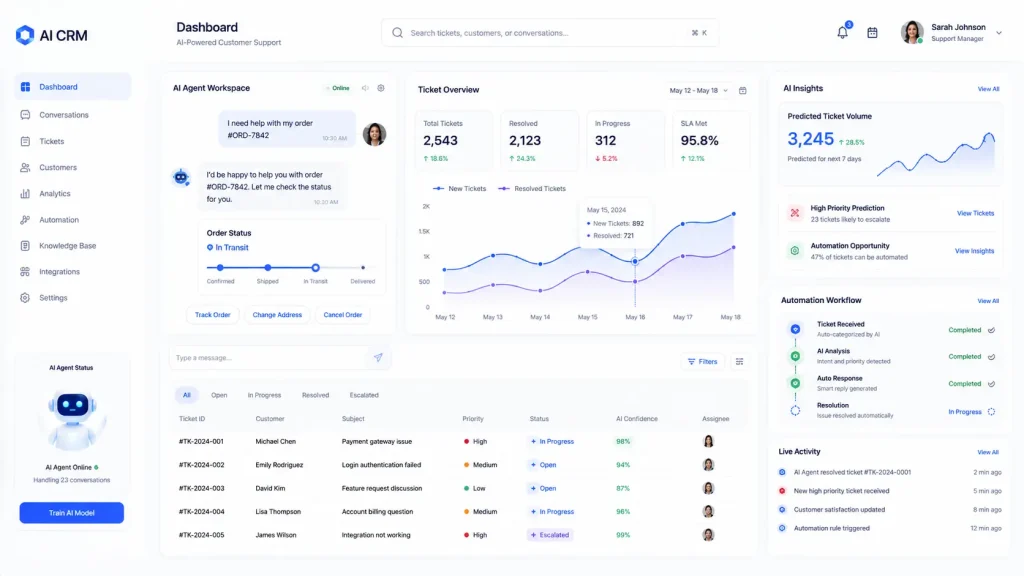
Modern AI systems classify incoming support requests by intent, urgency, and topic — then route them to the appropriate team, agent, or workflow automatically. This eliminates manual triage, reduces misrouting, and ensures high-priority issues reach specialized agents faster. Integration with platforms discussed in guides like AI automation for businesses ensures these workflows connect seamlessly to existing enterprise operations.
5. Continuous Learning and Improvement
Unlike static knowledge bases, AI chatbots learn from every interaction. Through reinforcement learning and ongoing model fine-tuning, they become more accurate over time, better at understanding customer language patterns, and more capable of handling edge cases that initially required human escalation.
6. Rich Data Collection for Business Intelligence
Every chatbot conversation is a structured data point. AI systems can analyze conversation logs to identify recurring pain points, unmet needs, product feedback, and sentiment trends at scale — providing customer intelligence that would require hundreds of hours of manual analysis to compile otherwise. This data feeds directly into CRM platforms, enabling smarter segmentation and proactive outreach.
AI Chatbot ROI: A Quick Reference Table
| Metric | Traditional Support | AI Chatbot Support | Improvement |
|---|---|---|---|
| Cost per interaction | $5–$12 | $0.25–$0.80 | Up to 94% reduction |
| Average resolution time | 4–10 minutes | Under 60 seconds | Up to 85% faster |
| Availability | Business hours | 24/7/365 | Always on |
| Simultaneous conversations | 1 per agent | Unlimited | Infinite scale |
| Ticket deflection rate | N/A | 40%–70% | Significant human offload |
| CSAT score impact | Variable | Consistently high | Improved consistency |
Real-World Use Cases: Conversational AI for Business
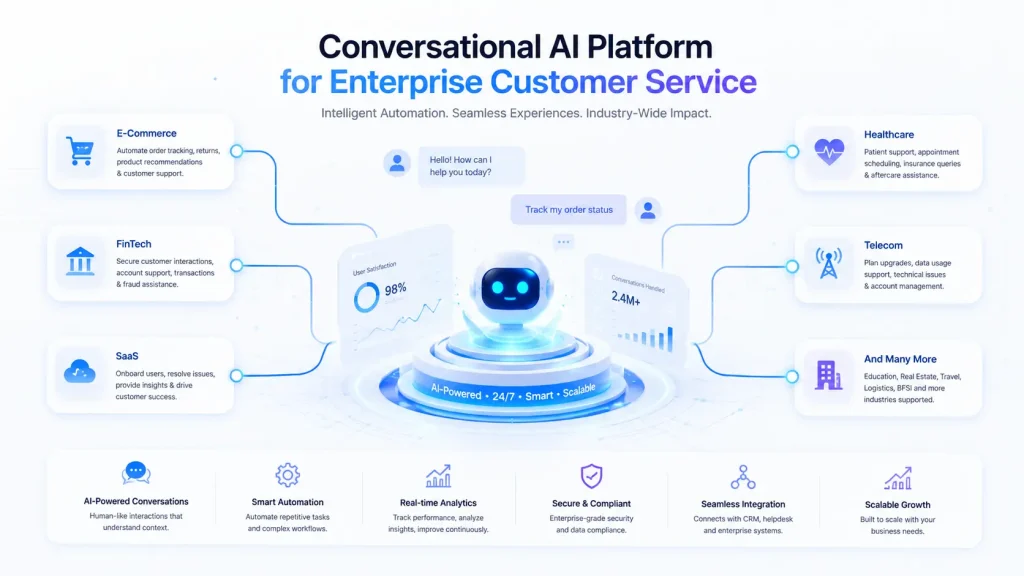
The strategic value of AI chatbots becomes clearest when examined through real industry applications. Across sectors, organizations are deploying conversational AI for business to solve high-volume, repetitive support challenges at scale.
E-Commerce: Order Management and Returns
Online retailers deploy AI chatbots to handle the highest-volume support categories: order status inquiries, return initiations, and shipping exception handling. By integrating with order management systems and logistics APIs, a chatbot can pull live order data, initiate return labels, and communicate estimated delivery windows — all without agent involvement. This alone deflects 40–60% of total support volume for most e-commerce operations.
Financial Services: Account and Compliance Queries
Banks and insurance companies use AI chatbots to handle balance inquiries, transaction history requests, policy questions, and claims status updates. These systems operate within strict compliance frameworks, authenticated via multi-factor identity verification, and integrated with core banking platforms. The result is faster service with full audit trail documentation.
SaaS and Technology: Technical Support Tier-1
SaaS platforms deploy chatbots as the first line of technical support, handling password resets, feature walkthroughs, integration guidance, and error code resolution. By connecting to documentation systems and user activity data via APIs, these bots provide contextually relevant answers — reducing the volume of issues that escalate to engineering or senior support staff. This directly supports the kind of AI workflow automation that modern SaaS operations depend on.
Healthcare: Patient Triage and Appointment Scheduling
Healthcare organizations use AI chat systems to handle appointment scheduling, pre-visit symptom collection, medication reminders, and insurance verification. These bots operate under HIPAA-compliant architectures, integrating with EHR systems and scheduling platforms to reduce front-desk workload while improving patient experience.
Telecommunications: Churn Prevention and Troubleshooting
Telecom companies leverage AI chatbots to handle service troubleshooting, plan change requests, and billing disputes. More strategically, they use AI to identify churn signals in conversation sentiment and automatically offer retention promotions — converting potential churn events into loyalty touchpoints without human intervention.
Challenges and Solutions in AI Chatbot Deployment
Despite their advantages, AI chatbot deployments come with real challenges. Enterprises that approach implementation without addressing these risks often experience poor adoption, user frustration, and suboptimal ROI.
Challenge 1: Handling Complex or Emotional Conversations
Problem: AI systems struggle with nuanced, emotionally charged, or highly complex scenarios where human empathy and judgment are critical.
Solution: Implement a robust human handoff protocol that transfers the conversation to a live agent when the AI detects escalation signals — such as negative sentiment, repeated frustration phrases, or topic complexity thresholds. The handoff should include full conversation context so agents don’t require customers to repeat themselves.
Challenge 2: Integration Complexity
Problem: Enterprise environments often involve legacy systems, siloed databases, and heterogeneous software stacks that are difficult to connect to AI platforms.
Solution: Prioritize chatbot platforms with robust API connectivity, pre-built CRM integrations, and webhook support. Platforms built on cloud-native architectures — such as those offered by AWS Lex and Google Dialogflow — provide extensive integration libraries that reduce implementation time significantly.
Challenge 3: Maintaining Accuracy and Trust
Problem: Outdated or incorrect chatbot responses erode customer trust and increase — rather than reduce — support volume as customers seek human clarification.
Solution: Establish a continuous content governance process. Connect the chatbot’s knowledge base to authoritative internal sources (product documentation, policy databases) and schedule regular accuracy audits. Use low-confidence fallback responses to escalate rather than hallucinate answers.
Challenge 4: Customer Adoption Resistance
Problem: Some customers resist automated interactions and immediately request human agents, limiting deflection rates.
Solution: Design chatbot interactions that are genuinely helpful, fast, and frictionless. Avoid making the bot feel like an obstacle to human access. When the bot successfully resolves an issue, customer preference for AI interaction increases over time. UI/UX quality matters enormously here — a polished conversational experience drives adoption far more effectively than forcing automation on reluctant users.
Future Trends in AI-Powered Customer Service Automation
The capabilities of AI chatbots are expanding rapidly. Enterprises investing in this space today need to understand where the technology is heading to make future-proof platform decisions.
Multimodal AI: Beyond Text
Next-generation AI support systems will process images, audio, and video alongside text. Customers will be able to send photos of defective products and receive instant troubleshooting — or speak naturally to voice-enabled AI agents that understand context across a multi-turn conversation. OpenAI’s multimodal research is already demonstrating the near-term viability of this paradigm.
Agentic AI: From Responding to Executing
The shift from reactive chatbots to agentic AI is perhaps the most significant near-term transformation. Agentic AI systems don’t just answer questions — they autonomously execute tasks. This includes initiating refunds, modifying subscriptions, updating CRM records, sending follow-up emails, and filing support tickets — all without human instruction. Understanding this evolution is critical for teams exploring AI agents for Customer Support as a strategic capability.
Hyper-Personalization Through Real-Time Data
Future AI support systems will draw on real-time customer data — purchase history, browsing behavior, support history, and predictive churn scores — to deliver hyper-personalized interactions. Every conversation will be tailored to the individual’s context, significantly improving resolution rates and customer satisfaction.
Proactive Support: AI That Reaches Out First
Rather than waiting for customers to contact support, AI systems will proactively identify potential issues — such as delayed shipments, failed payments, or unusual account activity — and reach out before the customer becomes aware of the problem. This shift from reactive to proactive support represents a fundamental change in the customer service model.
Best Practices for Deploying AI Chatbots at Enterprise Scale
Organizations that achieve the strongest ROI from chatbot deployments share consistent implementation discipline. The following best practices reflect enterprise-grade deployment standards.
Start with High-Volume, Low-Complexity Use Cases
Begin deployment on the queries that are most frequent, most repetitive, and least likely to require nuanced judgment. FAQs, order status, password resets, and appointment scheduling are ideal starting points. Prove ROI in these areas before expanding to more complex workflows.
Invest in Training Data Quality
The performance of any AI system is directly proportional to the quality of its training data. Invest time in building comprehensive, accurate, and well-labeled training datasets. Supplement with real conversation logs from your existing support history — this domain-specific data is the most valuable input for tuning chatbot accuracy.
Design for Seamless Human Escalation
The chatbot experience should feel like a smooth continuum with human support, not a barrier to it. Design escalation flows that preserve full conversation context, reduce wait time, and signal clearly to the customer when they are transitioning to a human agent. This design principle is central to any effective hybrid support model.
Measure the Right Metrics
Track metrics that reflect genuine business outcomes, not just activity:
- Containment Rate: Percentage of conversations fully resolved without human escalation
- Cost Per Resolved Contact: Total chatbot operational cost divided by resolved interactions
- CSAT for Bot Interactions: Customer satisfaction scores specifically for AI-handled conversations
- Escalation Rate: Percentage of conversations requiring human handoff
- Resolution Time: Average time from first message to confirmed resolution
Implement Governance and Continuous Improvement Cycles
Establish a regular review cadence — at minimum monthly — to audit chatbot performance, update knowledge bases, retrain models on new data, and incorporate agent feedback from escalated cases. Chatbot performance naturally degrades over time without active maintenance; treat it like a living product, not a set-and-forget deployment.
How AI Chatbots Improve Customer Support and Reduce Costs: The Strategic Summary
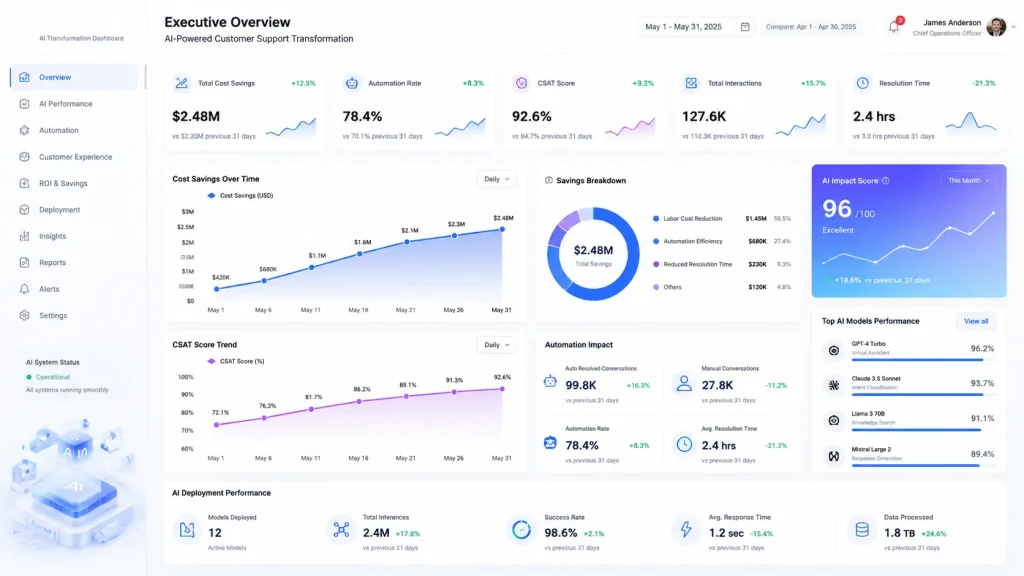
AI Chatbots Improve Customer Support and Reduce Costs by addressing the core structural inefficiencies of traditional support operations. They eliminate the cost ceiling imposed by human headcount, compress resolution times from minutes to seconds, enable 24/7 global availability without shift costs, and generate continuous intelligence from every customer interaction. For enterprises competing on customer experience while managing operational budgets, conversational AI is not an optional enhancement — it is a strategic imperative.
The organizations achieving the greatest results are those that approach deployment with clear business objectives, disciplined implementation, continuous optimization, and a commitment to genuine customer value — not just automation for its own sake. When these elements are aligned, the ROI is substantial, measurable, and compounding.
Frequently Asked Questions (FAQ)
1. How do AI chatbots reduce customer support costs?
AI chatbots reduce customer support costs by automating high-volume, routine interactions that would otherwise require paid human agents. They handle thousands of simultaneous conversations at a cost of under $1 per interaction — compared to $5–$12 for human-handled contacts — dramatically lowering cost per resolution. Additionally, they eliminate overtime, training, and turnover costs associated with human support teams.
2. What is the average ROI of deploying a customer support chatbot?
Most enterprise deployments achieve positive ROI within 6–12 months. Key drivers include ticket deflection rates of 40–70%, reduction in average handle time, and elimination of after-hours support staffing costs. Organizations with high monthly support volumes — typically 10,000+ contacts per month — see the strongest and fastest returns.
3. Can AI chatbots fully replace human customer support agents?
AI chatbots are not designed to fully replace human agents but to augment them. They excel at handling repetitive, high-volume queries, freeing human agents to focus on complex, emotionally sensitive, or high-value interactions that require judgment, empathy, and nuanced reasoning. The most effective deployments use a hybrid model where AI handles tier-1 support and escalates intelligently to humans when needed.
4. Which industries benefit most from AI customer service automation?
E-commerce, financial services, telecommunications, SaaS, and healthcare consistently see the highest ROI from AI customer service automation. These sectors share characteristics that favor AI deployment: high support volumes, repetitive query patterns, strong data infrastructure, and customer expectations for fast digital service.
5. How long does it take to implement an AI chatbot for customer support?
Implementation timelines vary by complexity. Basic chatbot deployments using cloud platforms like Dialogflow or Watson Assistant can go live in 4–8 weeks. Enterprise-grade deployments with deep CRM integration, custom NLP training, and multi-channel support typically require 3–6 months. Ongoing optimization continues post-launch and significantly impacts long-term performance.