What Is Predictive Analytics & How Brands Use It to Drive Smarter Decisions
Predictive analytics is transforming the way businesses operate, compete, and grow. In 2026, companies that rely on gut instinct alone are falling behind. Those that harness predictive analytics are forecasting demand, reducing churn, and personalizing customer experiences at scale — with precision that was impossible just a few years ago. This article breaks down exactly what predictive analytics is, why your business needs it, and how leading brands are using it right now to gain a measurable competitive edge.
What Is Predictive Analytics?
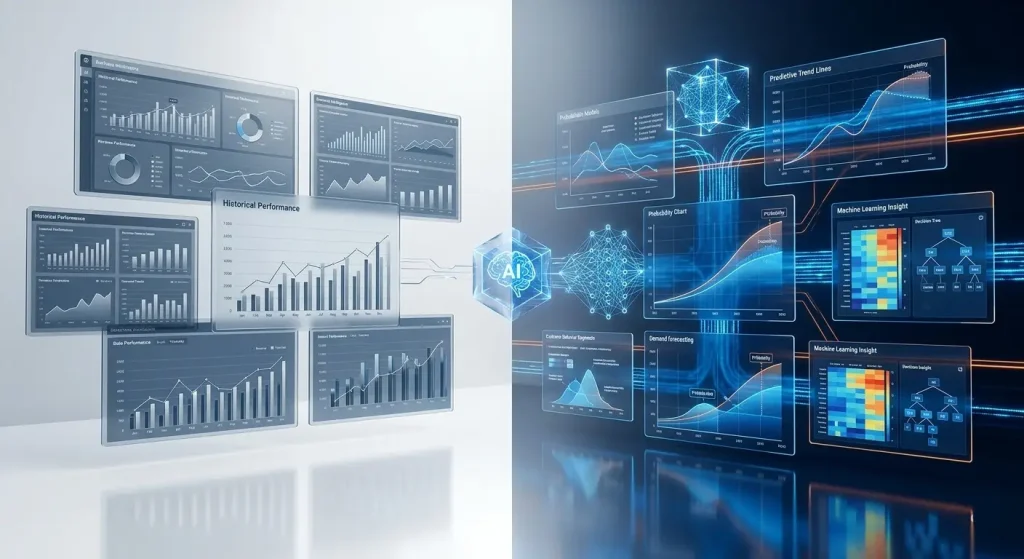
Predictive analytics is the use of historical data, statistical algorithms, and machine learning techniques to forecast future outcomes. Rather than simply reporting what happened in the past, predictive models identify patterns in existing data and use those patterns to make informed predictions about what is likely to happen next.
At its core, predictive analytics answers one fundamental business question: What will happen, and when? The technology draws from disciplines including data science, artificial intelligence, and business intelligence. It powers everything from Netflix’s recommendation engine to JPMorgan’s fraud detection systems.
Unlike descriptive analytics (which tells you what happened) or diagnostic analytics (which explains why it happened), predictive analytics is forward-looking. It empowers organizations to act before events occur — not just react after they do.
Core Components of Predictive Analytics
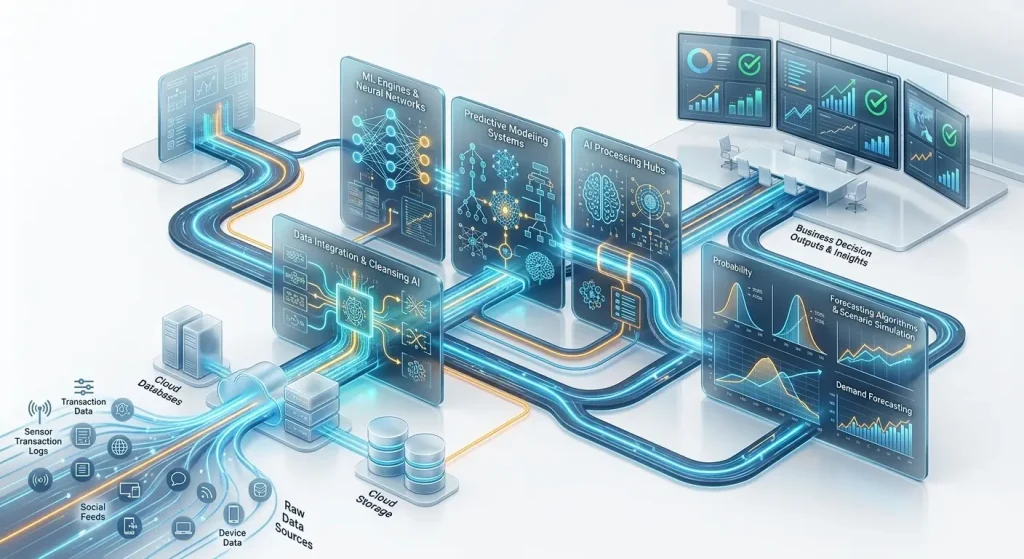
- Data Collection: Structured and unstructured data from CRMs, ERPs, IoT devices, social platforms, and transactional systems.
- Data Preprocessing: Cleaning, normalizing, and transforming raw data into model-ready formats.
- Predictive Modeling: Applying statistical algorithms — regression, decision trees, neural networks — to identify correlations and trends.
- Model Validation: Testing model accuracy against historical outcomes before deployment.
- Deployment & Monitoring: Embedding predictions into live business workflows and continuously refining models as new data arrives.
Why Businesses Need Predictive Analytics in 2026
The global predictive analytics market is on an aggressive growth trajectory. According to Gartner, AI-augmented analytics is now a top priority for enterprise data and analytics leaders. Businesses that integrate predictive analytics for business decisions are not just keeping pace — they are setting the pace.
Here is why the urgency has never been higher:
- Data volumes have exploded. Global data creation is expected to exceed 120 zettabytes annually by 2026. Without predictive tools, this data is wasted potential.
- Customer expectations are non-negotiable. Consumers now expect hyper-personalized experiences. Brands that cannot deliver relevance at scale will lose them to competitors who can.
- Margins are tighter. Rising costs in supply chains, customer acquisition, and operations make waste expensive. Predictive models help enterprises optimize every dollar spent.
- Competitive advantage is data-defined. In every major industry — retail, finance, healthcare, SaaS — the companies winning market share are the ones with the best data strategies.
Enterprises using IBM’s AI-powered analytics platforms have reported significant improvements in forecasting accuracy and operational efficiency. The shift from reactive to proactive decision-making is no longer optional — it is a survival imperative.
Key Benefits of Predictive Analytics for Business
The value of predictive analytics for business extends across every functional area of an enterprise. Below are the most impactful benefits organizations experience after adoption.
1. Improved Revenue Forecasting
Sales teams equipped with predictive models can accurately forecast pipeline health, identify high-converting leads, and prioritize accounts most likely to close. This reduces guesswork and aligns resource allocation with real opportunity.
2. Reduced Customer Churn
Churn prediction models analyze behavioral signals — login frequency, support tickets, feature usage — to identify at-risk customers weeks before they cancel. Retention teams can intervene proactively, saving revenue that would otherwise be lost.
3. Smarter Inventory and Supply Chain Management
Predictive models factor in seasonal demand patterns, supplier lead times, and macroeconomic indicators to recommend optimal inventory levels. This reduces both overstock costs and stockout events.
4. Enhanced Personalization
By predicting individual customer preferences, brands can deliver product recommendations, email content, and offers tailored to each user — at machine speed, without manual intervention.
5. Fraud Detection and Risk Mitigation
Financial institutions use machine learning for business intelligence to flag anomalous transactions in real time. Predictive fraud models dramatically reduce false positives while catching genuine threats before damage occurs.
6. Optimized Marketing Spend
Predictive attribution models help marketing teams understand which channels, campaigns, and touchpoints are most likely to drive conversions — enabling smarter budget allocation across the full funnel.
How Brands Use Predictive Analytics: Real-World Use Cases
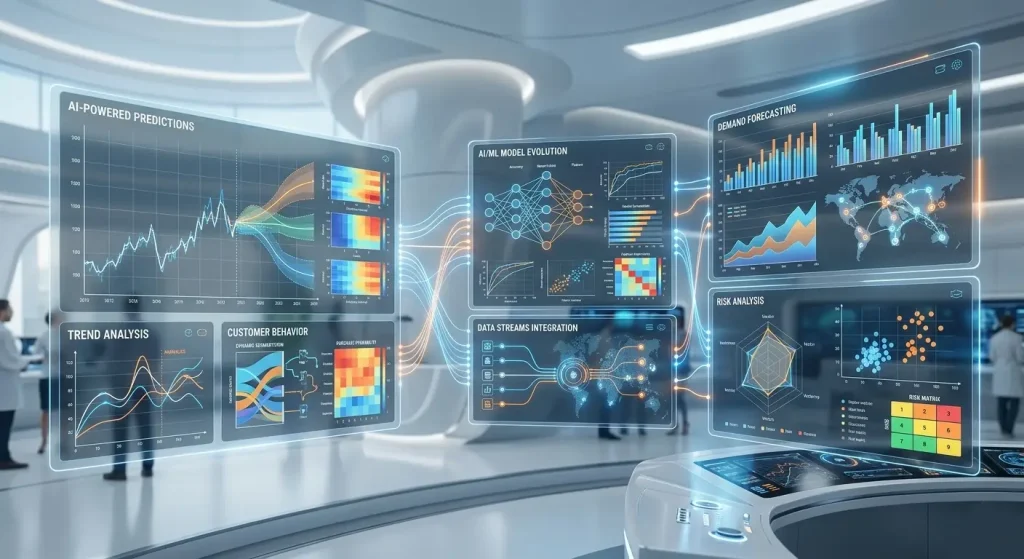
Understanding how brands use data analytics in practice makes the concept tangible. Here are proven, real-world applications across key industries.
Retail and E-Commerce
Retail giants use predictive analytics to optimize dynamic pricing, anticipate demand spikes, and reduce cart abandonment. Amazon’s recommendation engine — powered by collaborative filtering and real-time behavioral data — accounts for a significant portion of total platform revenue. Smaller e-commerce brands now access similar capabilities through cloud-based SaaS platforms and pre-built AI models.
Financial Services
Banks and fintech companies apply AI-powered data forecasting to credit scoring, loan default prediction, and market risk modeling. Microsoft’s Azure AI platform is widely used by financial institutions to build and deploy custom predictive risk models at enterprise scale.
Healthcare
Hospitals use predictive models to anticipate patient readmission risks, optimize staffing levels, and identify patients most likely to develop chronic conditions. Early intervention programs driven by predictive analytics are demonstrably improving outcomes while reducing costs.
SaaS and Technology Companies
SaaS platforms use predictive scoring models to identify expansion opportunities within existing accounts. Customer success teams receive early warning signals when usage patterns suggest a customer is unlikely to renew — giving them time to act. For deeper insight into how AI is reshaping enterprise SaaS, explore DTMetrix’s technology insights.
Manufacturing
Predictive maintenance is one of manufacturing’s most valuable use cases. IoT sensors on equipment feed real-time data to machine learning models that predict component failure days or weeks before it occurs — preventing costly downtime.
| Industry | Primary Use Case | Business Outcome |
|---|---|---|
| Retail & E-Commerce | Demand forecasting & recommendations | Higher AOV, reduced overstock |
| Financial Services | Fraud detection & credit scoring | Reduced losses, faster approvals |
| Healthcare | Readmission prediction & staffing | Better outcomes, lower costs |
| SaaS / Technology | Churn prediction & expansion scoring | Improved NRR, higher retention |
| Manufacturing | Predictive maintenance | Reduced downtime, lower OPEX |
Challenges of Predictive Analytics — and How to Overcome Them
Implementing predictive analytics is not without friction. Business leaders must navigate several common obstacles to extract real value.
Challenge 1: Data Quality and Silos
Predictive models are only as good as the data they train on. Fragmented data stored across disconnected CRMs, ERPs, and spreadsheets produces inaccurate predictions. Solution: Invest in a unified data infrastructure — a data warehouse or lakehouse — before building models. Platforms like AWS analytics solutions offer scalable data lake architectures designed for enterprise-grade predictive workloads.
Challenge 2: Lack of Internal Expertise
Building custom predictive models requires data science talent that many businesses lack. Solution: Leverage AutoML platforms and managed AI services that abstract away the complexity. Many SaaS vendors now offer embedded predictive features that require zero data science experience to use.
Challenge 3: Model Drift
Predictive models degrade over time as market conditions, customer behavior, and business contexts change. A model trained on 2023 data may perform poorly in 2026. Solution: Establish model monitoring pipelines that track accuracy metrics continuously. Retrain models on a scheduled cadence or trigger retraining automatically when performance drops below defined thresholds.
Challenge 4: Change Management and Adoption
Even the most accurate predictions are worthless if teams don’t trust or act on them. Solution: Embed predictions directly into the tools teams already use — CRM dashboards, sales platforms, marketing automation workflows. Reduce friction between insight and action.
Challenge 5: Privacy and Compliance
Predictive analytics often involves sensitive personal data. GDPR, CCPA, and sector-specific regulations impose strict requirements on how data is collected, stored, and used. Solution: Build privacy-by-design principles into your data infrastructure from day one. Use anonymization and differential privacy techniques where possible.
Future Trends in Predictive Analytics
The next wave of AI-powered data forecasting will be defined by several emerging capabilities that are already reshaping the landscape.
Real-Time Predictive Analytics
Streaming data pipelines now enable predictions to be generated and acted upon in milliseconds. Real-time predictive scoring is becoming the standard for fraud detection, dynamic pricing, and personalized web experiences.
Generative AI and Predictive Synthesis
Large language models are being combined with traditional predictive models to generate narrative explanations of forecasts. Instead of just a churn probability score, business users receive a plain-English explanation of why a customer is at risk and what action is recommended.
Causal AI
Traditional predictive models identify correlation. Causal AI goes further, identifying cause-and-effect relationships. This distinction is critical for business decisions where understanding why something will happen is as important as predicting that it will happen.
Edge Analytics
As IoT deployments scale, predictive models are being pushed to edge devices — running locally on sensors and equipment without requiring cloud connectivity. This dramatically reduces latency for time-critical predictions in manufacturing, logistics, and healthcare.
Federated Learning
Federated learning allows predictive models to train on distributed data without the raw data ever leaving its source environment. This enables cross-organizational collaboration on AI models while maintaining strict data privacy — a breakthrough for regulated industries.
Best Practices for Implementing Predictive Analytics
Organizations that succeed with predictive analytics for business follow a disciplined implementation approach. These best practices will help you maximize ROI and avoid the most common pitfalls.
- Start with a clear business problem. Define the specific decision you want to improve before selecting models or tools. Vague objectives produce vague results.
- Audit your data assets first. Understand what data you have, where it lives, how complete it is, and whether it is reliable before investing in model development.
- Choose the right modeling approach. Not every problem requires deep learning. Simpler models — logistic regression, gradient boosting — often outperform complex ones when data is limited or interpretability is required.
- Integrate predictions into workflows. Deliver predictions inside the tools your teams already use. The shorter the path from insight to action, the higher the adoption rate.
- Measure business impact, not model accuracy. A model with 85% accuracy that drives measurable revenue improvement is more valuable than one with 95% accuracy that sits unused.
- Build a continuous improvement loop. Treat your models as living systems. Collect feedback, monitor performance, and iterate regularly.
- Invest in data literacy across teams. Predictive analytics delivers maximum value when business users understand how to interpret and act on model outputs — not just when data scientists build models in isolation.
For organizations looking to accelerate digital transformation through machine learning for business intelligence, partnering with experienced technology consultants can compress the timeline from strategy to deployment significantly. Learn more about how Salesforce Einstein embeds predictive intelligence directly into CRM workflows.
Predictive Analytics vs. Traditional Business Intelligence
| Capability | Traditional Business Intelligence | Predictive Analytics |
|---|---|---|
| Time Orientation | Backward-looking (what happened) | Forward-looking (what will happen) |
| Data Usage | Historical reporting | Pattern recognition & forecasting |
| Decision Type | Reactive | Proactive |
| Technology | SQL, dashboards, reports | Machine learning, AI models |
| Business Impact | Improves understanding | Drives competitive advantage |
Frequently Asked Questions About Predictive Analytics
What is predictive analytics in simple terms?
Predictive analytics uses historical data, statistics, and machine learning to forecast future events. It helps businesses anticipate outcomes — like customer churn, demand spikes, or fraud — before they happen, enabling proactive decision-making.
How is predictive analytics different from machine learning?
Machine learning is a technique used within predictive analytics. Predictive analytics is the broader business practice of forecasting outcomes. Machine learning algorithms — such as gradient boosting or neural networks — are the tools that power many predictive models.
What industries benefit most from predictive analytics?
Financial services, retail, healthcare, manufacturing, and SaaS technology are among the highest-impact sectors. However, virtually every data-generating industry — from logistics to education — can extract measurable value from predictive analytics.
How much data do you need to build a predictive model?
The data volume required depends on the complexity of the problem and the modeling approach. Simple regression models can work with hundreds of records. Deep learning models may require millions of data points. In many cases, data quality matters more than raw volume.
What tools are used for predictive analytics?
Common tools include Python (scikit-learn, TensorFlow), R, Google BigQuery ML, Amazon SageMaker, Microsoft Azure Machine Learning, Salesforce Einstein Analytics, and Tableau with Einstein Discovery. The right tool depends on your team’s expertise, data infrastructure, and specific use case.
Conclusion: The Business Case for Predictive Analytics Is Undeniable
Predictive analytics is no longer the exclusive domain of Fortune 500 companies with dedicated data science teams. In 2026, cloud platforms, AutoML tools, and embedded AI capabilities have democratized access to powerful forecasting technology for businesses of every size.
The brands that are winning — in customer retention, revenue growth, operational efficiency, and market positioning — are those that have moved from descriptive reporting to predictive intelligence. They are not just analyzing the past. They are engineering their future.
Whether you are a SaaS startup looking to reduce churn, a retail brand trying to optimize inventory, or an enterprise company building a data-driven culture, predictive analytics offers a clear, measurable path to better outcomes. The question is no longer whether to adopt it — it is how fast you can do so before your competitors do it first.
Ready to explore how data-driven intelligence can transform your business operations? Discover the full range of technology solutions and insights available at DTMetrix and take the first step toward building a genuinely predictive enterprise.